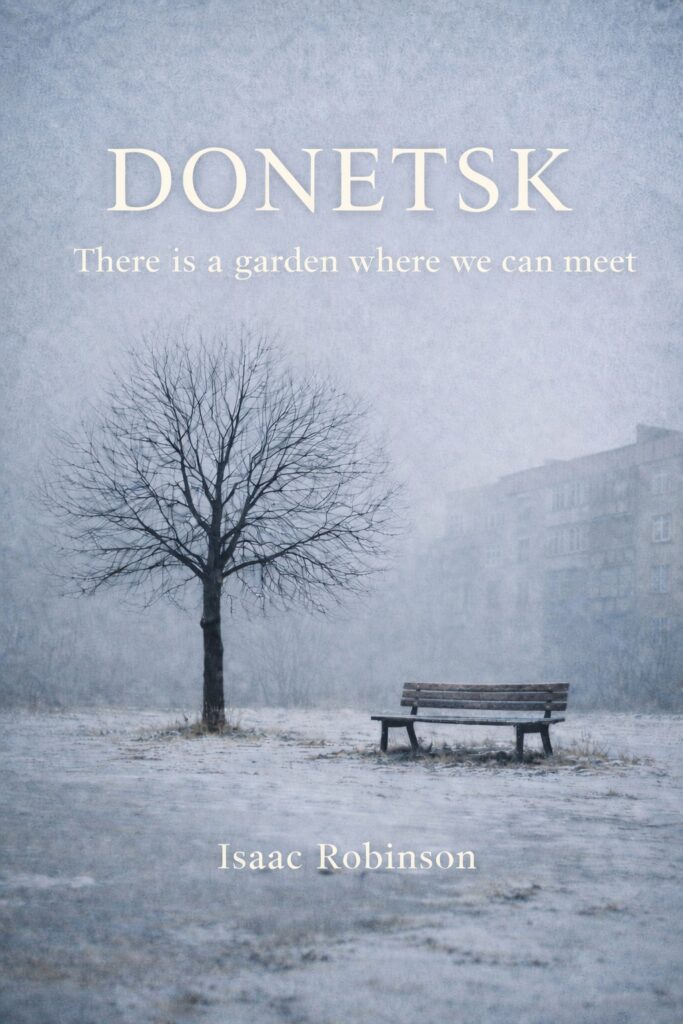
What happens when the world you know vanishes overnight? In Donetsk, a young woman’s life unfolds across ten years of war, shifting borders, and unrelenting uncertainty. Amid missiles, drones, bunkers, and the deafening silence of abandoned cities, Masha navigates the wreckage of a country—and a family—torn apart. Her girlhood crumbles in real time, but her voice only sharpens. She refuses victimhood. She won’t play by the rules. And she’ll tell you everything.
From the funeral smoke of Mariupol to the bureaucratic absurdity of Kyiv, Masha’s journey is raw and unforgettable. As economies collapse and ideals rot, she stands alone—cynical, observant, and emotionally honest in a world that demands conformity. Love doesn’t come easy. Grief doesn’t knock. Survival is a full-time job. Through political mazes, lost pensions, broken systems, and shattered friendships, Donetsk tells the truth few want to hear: war doesn’t just kill—it rewires.
Can a soul stretched by loss ever return to shape? Masha carries death and memory like a second skin, but never lets them define her. She questions everything—God, nation, rights, even love. But is it possible, in the great design of the universe, that she, too, might belong somewhere? Donetsk is not a story of hope. It’s a story of survival that dares to ask—what if survival is enough?
Goodbye Donetsk
A Sunday slips out of place. Shelling nearby, an empty park, a home that suddenly weighs too much to carry. What is packed is survival; what is left behind is everything else—graves, love, routines, dignity. As the car pulls away, Donetsk does not end; it follows.
You Are the Information in You
Kyiv looks calm, almost rehearsed. Lecture halls instead of checkpoints, conversations instead of sirens. But displacement doesn’t fade—it rewires. New faces, new ideas, and a voice that cuts through comfort begin to expose how power settles quietly, how authority is learned, and how belief takes root. Identity, she realises, is not fixed or chosen. It is assembled. And once assembled, it can be steered.
Where Water Rots, the Hyacinth Blooms
Bad news thickens around Donetsk. Silence replaces reassurance, aid arrives with quiet tests of dignity, and survival begins to negotiate with pride. Kyiv offers light by the river, music, colour—but none of it settles the weight carried inside. A conversation breaks open what war usually hides: how violence is learned, scaled, and justified; how freedom is surrendered long before it is taken
War Is Not a Malfunction
War slips into routine. Chickens, sewing, job searches, rent—adaptation becomes skill, not choice. Survival reorganises itself as daily work. By the river, war is named plainly—not a malfunction, but a system. Capital grows, money multiplies, destruction creates demand. And still, care persists: shared food, small gifts, quiet loyalty. Life does not confront war head-on. It endures—patiently, stubbornly, together.
Life is a Blanket on a Winter Night
Home is pieced together again—rented rooms, familiar food, old rituals revived against the cold. Love works like a blanket on a winter night: it covers, but never quite reaches both head and feet. Then the State arrives. Doors open, hands close, silence becomes instruction. What follows is not justice but exposure—to fear, to power, to how easily a life can be folded away. When release comes, it is conditional. And warmth no longer means safety.
Hell: The Finest Masterpiece of Human Ingenuity
Release does not end captivity. It only changes its shape. The body heals; the mind keeps walking locked corridors. By the sea, hell is dismantled—not as fire or punishment, but as design: fear engineered, obedience trained, guilt weaponised. Power survives by persuading people to police themselves. Pain remains. Suffering becomes a choice. And survival, at last, turns inward.
Fox in the Henhouse
Life resumes on the surface: classes, part-time work, rented rooms, the small dignity of earning and routine. Beneath it, the system keeps taking—pensions stalled, labour drained, value quietly erased. Ideas harden into structures, structures into theft. Money promises freedom, then ages into a trap. And just as the logic becomes clear, the war reaches back—personal, final—reminding her what systems ultimately consume, and who they leave behind.
The World Belongs to Ordinary People
Loss strips life down to its frame. Love, work, security—gone in quick succession—until grief feels like a permanent condition. Borders close, systems fail, and death arrives without ceremony. And still, life continues. In trees, seasons, friendship, and breath, she sees it clearly at last: the world does not belong to those who control it, but to those who live in it.
Where is Debu
Stability returns just long enough to feel real—jobs, plans, a future sketched in pencil. Then war arrives without warning, tearing the city open and driving lives underground, onto roads, across borders. In the scramble to survive, something innocent is left behind. A life with no language or flags, no stake in power or territory. As cities burn and people flee, one question remains—quiet, brutal, and unanswered: who gets to escape, and who is abandoned to the fire?
An Ode to No One
War becomes procedural. Aid arrives wrapped in forms, strategies, and photographs, while grief moves faster than systems can follow. Funerals pass on the roadside; names blur into numbers. In cities learning to live underground, life continues—beer opened with keys, children raised on sirens, spring insisting anyway. And above it all, the question remains unresolved: how to honour the dead without letting their silence consume the living.
Flirting at the Gate of Erebus
When the State comes for her father, fear turns practical. Love becomes strategy. Morality thins under pressure, and survival slips quietly into illegality. Between hiding, bargaining, and running out of time, despair reaches its edge. At the threshold between life and disappearance, she flirts with oblivion—only to be pulled back, reminded that existence needs no meaning beyond the act of continuing.
There is a Garden Where We Can Meet
Borders bend where care insists. Papers, routes, and rules are rearranged so one body can return, one family can hold together a little longer. Death arrives quietly, without drama or resistance. What remains is not closure, but clarity: life moves like wind and water, indifferent to belief or blame. And somewhere beyond ideology and loss, there is still a place—unguarded—where we can meet.