CHAPTER TWO
You Are the Information in You
A month has passed since Papa left. I’ve adapted to the new life. Sort of.
The first two days were brutal. It was like someone had scooped out a chunk of my chest and left the wind whistling through. That hollow feeling wouldn’t leave — it kept tiptoeing in without knocking. And it wasn’t just sadness. It was fear.
What if I never see Grandpa again? Or Igor?
I left Papa, Mama, and Sasha behind in that lifeless dacha in Volnovakha, surrounded by silence and uncertainty. And here I am — in peaceful, polished Kyiv. It’s maddening.
Katya, my roommate, can talk.
She kept her distance the first couple of days — polite, formal, nothing too personal. But the moment we stepped into the common kitchen together, she cracked open her chatter box like it was spring-loaded.
Since then, she’s barely left me a moment to dwell on my displacement saga.
Katya came from Rivne a year before I did. Her first year was a series of flops—like many smart village kids who land in the capital glowing with ambition and blind optimism. That phase is long gone. She’s now running a tight three-stop loop: university lectures, paid coaching gigs, and a tireless devotion to polishing the same familiar masterpiece—her beautiful body.
Her attempt to pass as a trophy for the elite boys at KIMO ended in a graceful nosedive. They’re too sharp for that—one private drink and they sniff out the village in you.
If your outfit doesn’t give it away, your accent will. Or the way you light up at a sip of wine. Rule one: don’t ask what you’re drinking. Don’t marvel at the taste. If you truly belonged to their world, you’d already know.
Today, Katya and I are off to a lecture on… humanitarian law or human rights law or something — I’m not entirely sure. Uncle Vlad called last week, insisting I sign up for the series. His boss, some war-zone veteran, is speaking at KIMO to “inspire young minds.” After some heavy lobbying, Katya has even “volunteered” to come along.
The first lecture was surprisingly interesting. Not that we grasped much of it, but it was the way he spoke—and, honestly, the man himself. A Black man from Uganda named William Okello Labongo. His style was anything but ordinary, which made it easy to stay tuned, even if half of what he said sailed right past us.
Students crowded around him after the lecture, tossing questions and trailing him to the canteen just to keep talking. Katya and I were too shy to elbow our way in, so we decided to wait for next time. William Okello Labongo, prefers to be called Okello, from Uganda—there’s something undeniably exotic about him, and Katya’s itching to know more. Honestly, who wouldn’t be curious? A Black African man named William—it’s not exactly what you expect.
Okello’s second lecture went down easier. It was on humanitarian principles. As planned, we joined the crowd and followed him to the canteen. The guy clearly loved to talk—and he wasn’t in any hurry to head home.
When everyone else drifted off, Katya and I stayed behind. She pulled out her endless list of questions. He mentioned he’s from the Acholi people—originally from what is today South Sudan, now mostly settled across northern Uganda, in Gulu and the surrounding districts. I have to admit, in one evening, I learned more about Africa than I had in my entire life.
Unsurprisingly, Katya dropped out after the third lecture—her curiosity had been satisfied. I kept going. Okello’s no longer a stranger; he even recognizes me now. And each time we talk in the canteen after class, I find myself a little more drawn in—not just by his ideas, but by the clarity and force of his arguments.
Okello came from a religious Christian family. He’s the third child—the only son. He has twin elder sisters, which makes his name Okello, meaning the child born after a twin. He spent most of his childhood in Gulu, in northern Uganda, among the Acholi people. Both sisters married local Acholi men at a fairly young age and eventually settled in Kampala.
Okello was sent to boarding school in Kampala—there were no decent options in the north. His parents remained in Gulu until 1996, when the government forced hundreds of thousands of Acholi into camps during the insurgency led by Joseph Kony’s Lord’s Resistance Army.
His parents managed to avoid the camps. His father held an influential post in the Gulu Diocese of the Anglican Church, and with the Church’s help, he and his wife secured visas to England, where they eventually settled. Okello joined them years later, after finishing high school and college in Kampala—by then, his parents had gained legal status and were able to sponsor his move through a formal migration process.
Okello studied law at Cambridge, passed the bar, and became a barrister in London. Later, his Ugandan background helped him land a scholarship to Harvard, where he completed his postgraduate studies in human rights and international law.
Okello broke his father’s heart when he chose a humanitarian field job in the Balkans instead of returning to London to practice law. To his father, it was a waste—years of talent and education poured into low-status fieldwork with little recognition. But Okello loves what he does, despite the fact that working in conflict zones still scares him.
Two weeks have slipped by since Okello’s lecture series wrapped up. Mykyta—Katya’s boyfriend—has grown increasingly curious about him. After hearing one story too many, he wants a meeting of his own. So we’ve arranged one. This afternoon, the three of us will meet Okello at St. Sophia’s Square, once he’s done with his office hours.
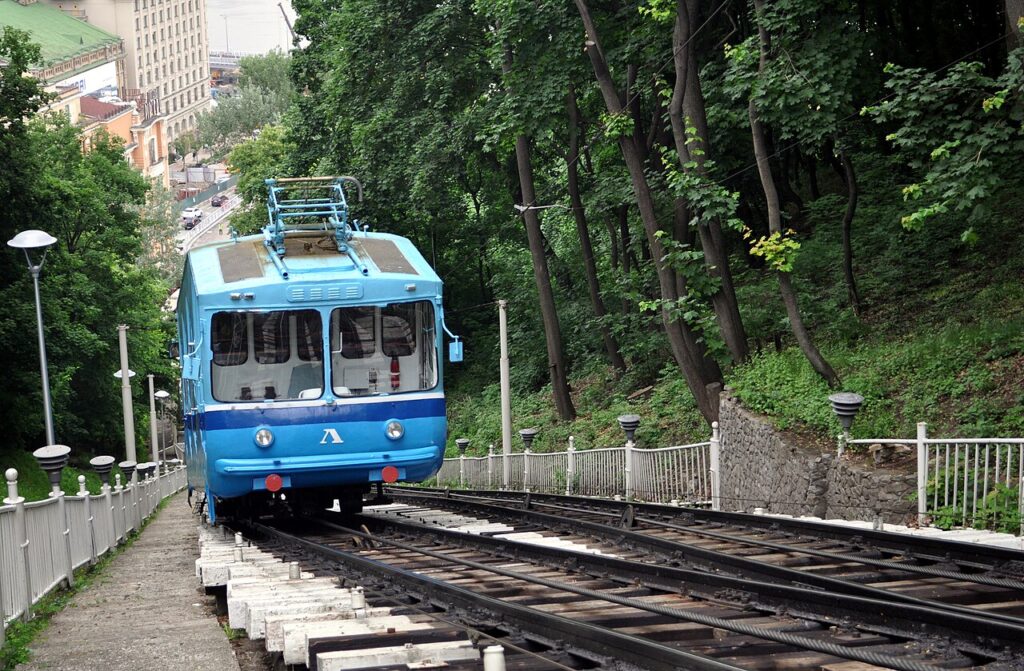
Kyiv Funicular — Photo: Pawel Szubert
Mykyta is in his final year at KIMO and recently started an internship at the Ministry of Foreign Affairs. Katya and I met him outside the Ministry’s colossal façade. We had a bit of time before the meeting, so he took us on a short walk around the area—pointing out the funicular railway, a quiet park overlooking the Dnipro, the golden domes of St. Michael’s Monastery, and a nearby five-star hotel. We met Okello just as we reached St. Sophia’s Cathedral.
Mykyta and Okello exchanged a few light words of introduction, and we started walking toward St. Andrew’s Church. According to legend, St. Andrew—one of the twelve apostles—passed through these lands in the 1st century AD. When he reached the hills above the Dnipro, St. Andrew stopped and said: “Do you see these hills? Upon them shall shine the grace of God. A great city will rise here, and many churches will be built in His name.”
As we were about to cross the edge of St. Sophia’s Square, Okello paused beneath the towering statue of Bohdan Khmelnytsky. He pointed his finger at the bulawa in Bohdan’s outstretched arm and asked:
“What do you think? Where is the bulawa pointing?”
Mykyta was a little startled—he had only just met Okello and wasn’t yet familiar with his habit of asking sudden, offbeat questions. He offered a careful smile and replied gently.
Mykyta
I’m not sure… maybe toward the Dnipro? Or the Ministry building across the square? Could it be St. Andrew’s Church too?”
Okello
I don’t know either. But I do know the old Soviet joke that a taxi driver told me. It says Bohdan Khmelnytsky was warning the people of Kyiv: if you don’t agree with the communist regime, we’ll send you to the NKVD.
Mykyta
Where do you see the NKVD building?
Okello
Look straight across the street—about fifty meters from here.
Mykyta
That’s the Research Academy of the Security Service of Ukraine. You think the NKVD used that building during Soviet times?
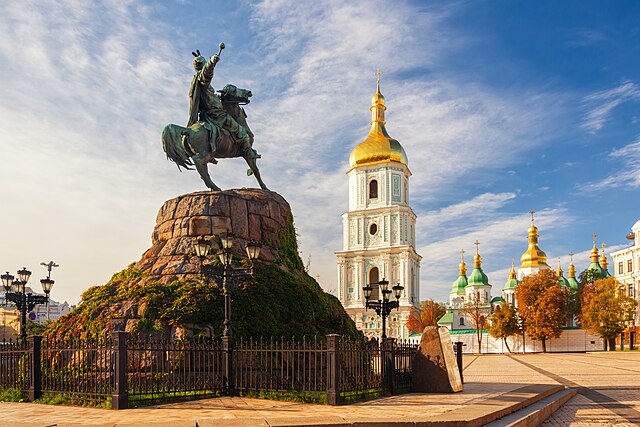
Bohdan Khmelnytsky at St. Sohia Square - Photo:Rbrechko
Okello
Yeah. That building was originally the NKVD headquarters. When the NKVD was dissolved, it became the MGB office—and later, the KGB’s base in Kyiv.
Mykyta
You seem to have studied the Soviet Union quite a bit.
Okello
I have, actually—and I keep learning whenever I get the chance. Soviet history fascinates me. Not because I’m a fan of it, but because it offers a lens to compare and contrast with other societies.
Katya
It feels strange. A place like that, sitting right in the middle of all this cultural heritage.
Okello
That’s exactly the point. Think about it—the NKVD headquarters were placed right in the middle, almost equidistant from three of Kyiv’s most iconic religious sites: St. Sophia’s Cathedral, St. Andrew’s Church, and St. Michael’s Monastery.
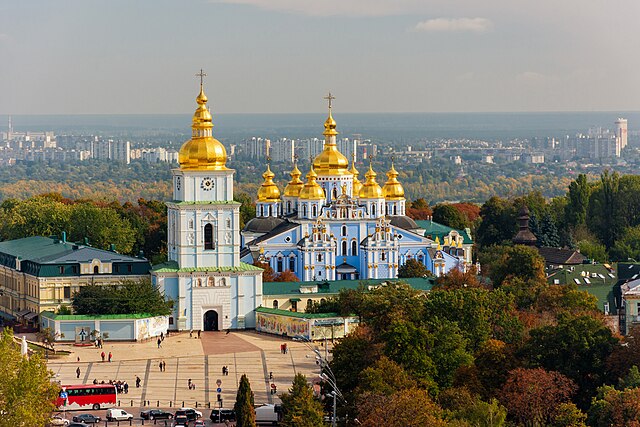
St. Michael's Monastery - Photo: Rbrechko
I
You think they wanted to spy on the churches? The communists were always suspicious of religious people.
Okello
More than that. Churches represented power. The Soviets wanted to make a clear statement—power no longer came from heaven, but from men in stone buildings.
I
Is that why all the Soviet-era government buildings in Kyiv have such monstrous architecture?
Katya
Not just in Kyiv. Even in the most remote villages across Ukraine, the Local authority buildings from Soviet times are often larger and more imposing than the churches.
Mykyta
There’s an anecdote that when the Soviets built the Motherland Monument in Kyiv, one of their design requirements was that it had to be taller than the belfry of Kyiv Pechersk Lavra.
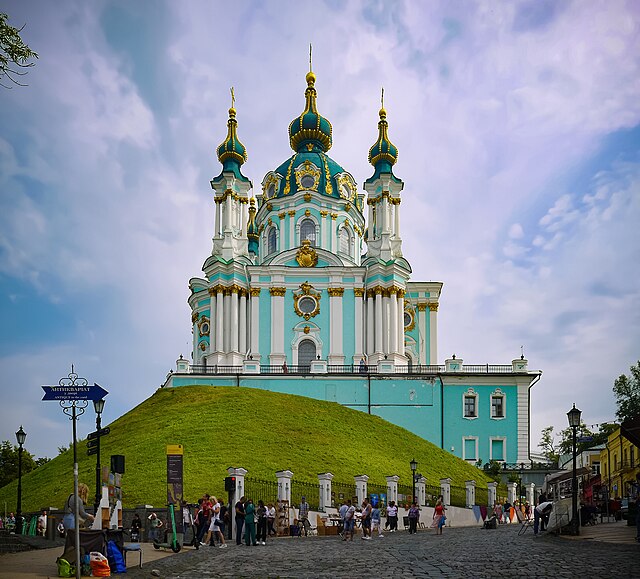
St. Andrew's Church - Photo: Posterr
Okello
The power of authoritarian regimes like the Soviets—and that of the Churches—are both centralized by nature. One threatens the existence of the other. Just follow the chronology and you’ll see how that tension played out.
In 1934, the capital of the Ukrainian SSR was moved from Kharkiv to Kyiv. That same year, the NKVD set up its headquarters right here. And in 1935, they demolished St. Michael’s Monastery—officially for urban planning. It wasn’t rebuilt until the 1990s.
I
But the Church hasn’t held real power for centuries—not since the separation of church and state.
Okello
That’s a big discussion. But first, we need to stop somewhere for a beer.
We kept walking toward St. Andrew’s Church, then made our way down Andriyivskyy Descent. Okello claimed he knew a place that served the best pork ribs in the “world.” We paused briefly outside Bulgakov’s former residence, then continued to a restaurant at the bottom of the hill. We ordered grilled pork ribs and beer all around. Okello added a piece of palianytsia for himself.
Over ribs and beer, the conversation drifted back to power. Okello told us about his Pekingese—a tiny dog that acted like the king of the house. When his wife brought home a five-week-old German Pointer, the Pekingese immediately took charge, bossing the puppy around. Within a year, the Pointer had grown to nearly three times bigger than the Pekingese—but the hierarchy never changed. The Pekingese still ruled—over the house, and over the much larger dog. “You see,” Okello said, “Power isn’t about what you have—it’s about what others accept you have.”
I
You don’t see the Church forcing anyone to do anything, do you?
Okello
Whether you obey out of fear of something real—like the NKVD—or out of belief in something abstract, what’s the difference? Think about my German Pointer. There was no real threat coming from the Pekingese, yet it still obeyed him.
Mykyta
Why do we accept the authority of others so easily? Is it because human is a weak species?
Okello
Indeed. We’re a weak species—far weaker than many others.
Lions have powerful jaws and claws. Antelopes run 90 kilometres an hour. Dogs can smell 10,000 times better than we can. Eagles spot prey from three kilometres away. Rabbits leap and twist at high speed. Hedgehogs turn into bristling balls of armour.
We, with no real defences, survive through social cooperation. And because we rely on others for protection, we’re naturally inclined to trade freedom for safety.
I
But we have intelligence. If we see someone is abusing us, we will walk away from that, right? It happened in Soviet Union too. People obliged because they were forced to. But most people did not accept it.
Okello
That’s only if you even realize someone has power over you.
The most remarkable person I ever met was at my missionary boarding school in Kampala—Father Warren Hastings. He looked like a saint from a painting: pale skin, blue eyes, not a wrinkle on his face. Always wore a spotless white cassock with a blue trim.
But it wasn’t just how he looked—it was how he carried himself. Calm, kind, soft-spoken. He didn’t just talk about love and forgiveness—he lived it. He even learned Luganda to connect with locals. When society ignored the poor, the sick, the rejected—he was there. If you had leprosy and everyone would abandon you, he’d show up with medicine and respect.
Now, put yourself in the shoes of an average Ugandan. Would you question whether this man—so kind, so good—is also part of a colonial system? Probably not. You just see a saint.
Mykyta
You mean our minds are already wired that way? Like—we’re trained to follow without even thinking about it?
Okello:
Everything about us is driven by information. Some of it is built into us, like in our DNA. That’s the biological part—a crazy long code that controls how we grow, how our body works, even what colour our eyes are.
Our biological responses also depend on signals from our surroundings—like light, food, or temperature. All those little things tell our body what to do: when to wake up, when to feel hungry, or even how stressed we should feel.
Then there’s the social side. Our brain stores memories of what people said or did, and how that made us feel. One part remembers the facts; another handles emotions like fear or excitement. Together, they shape how we react in social situations—what we say, how we behave, even what we believe.
So, who are you? You’re basically a collection of information—what’s written in your genes and stored in your mind. And if someone can control that info, they can control you.
You are the information in you.