CHAPTER SIX
Hell: The Finest Masterpiece of Human Ingenuity
Papa booked intercity train tickets for both of us to Zaporizhzhia for this morning, right after I was released from detention. He also arranged for one of his colleagues to drive us from Zaporizhzhia to Mariupol.
Okello came to the station to see me off. Katya had called him last night to update him, I hadn’t spoken. We had only a moment on the platform before boarding. I didn’t get the chance to thank him properly. He was the one who pushed the ICRC, the Red Cross, to open an investigation into my disappearance. He even got the UN human rights office to raise concerns.
I haven’t told anyone about Uncle Vania’s role yet. I just dropped a small hint to Grandpa when we talked last night. And I could tell he picked it up right away. It’ll stay between the two of us.
Katya came with me to the station too. No lipstick, no powder on her face. She’d forgotten all that over the past seven days. Worry had taken up residence there.
It’s been a week now since we arrived in Mariupol. I’ve spent most of my time in bed. Physically, I’ve recovered. Mentally, I don’t know. Mama keeps telling me to leave the flat, to do something. So now Benichka and I walk Sasha to school in the morning and pick him up in the afternoon. It’s become a routine.
Each day after we drop Sasha off, Benichka and I make our way to the western edge of the city, where the Azov stretches out before us. It doesn’t impress at first, especially if you’ve seen the beaches in Crimea, with their clear waters, rocky cliffs, and soft sands in places like Sevastopol, Sudak, or Yalta
Last Saturday, Papa took us on a tour of Mariupol. No surprise, he drove us past the giant steel mills first. With its strategic location near the port, Mariupol was an obvious choice for the Soviets when they developed heavy industry. After Donetsk city, it’s the second-largest city in Donetsk Oblast. I learned something new that day: the town was founded by Greek settlers about 250 years ago. Papa said he has colleagues at work who look different from most Ukrainians and still speak Greek..
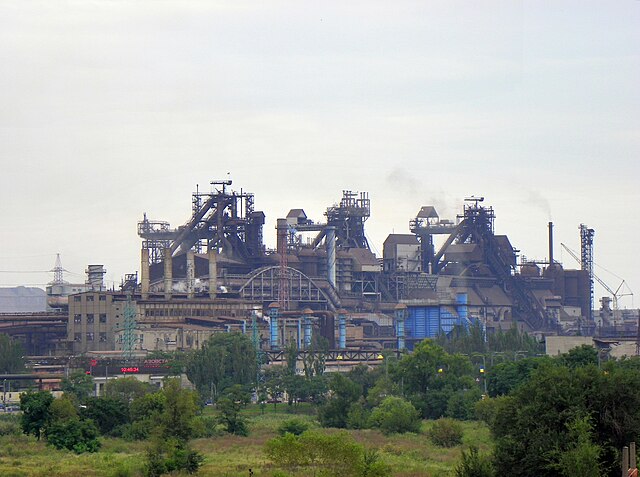
Azovstal, Mariupol. Photo: WikiMedia Commons, license link

I was stunned when Papa drove past Azovstal, one of Mariupol’s giant steel mills, spread across thousands of acres. I had never imagined a factory could be so vast. We passed mile after mile of towering structures, heavy machinery, and endless rows of industrial buildings. A train line ran through the complex, with dozens of wagons—some open, some sealed—carrying coal into the mill. The sound of the train cut through the air, steady and mechanical.
I asked Papa where the coal came from. He said it was mined in Shakhtarsk and Makiivka, places controlled by the separatists. The coal travelled by train through Yasynuvata and Volnovakha, all the way to Mariupol. No one stopped it. Not the separatists. Not the government. But when people try to cross that same route to see their families, everyone gets paranoid.
Okello called to say he’s coming to Mariupol in a few days. The humanitarian organization he works for has a hub here, like most of the big ones. He visits once a month for a day or two to check on field work. We first agreed to meet at a café near his office, but Mama insisted he come for dinner at home. Okello said yes.
During dinner, Okello kept circling back to my studies at KIMO. It felt like he was on a mission to convince me to return to Kyiv. My parents agreed with him, but I wasn’t convinced. Honestly, his involvement in something so personal made me a little uncomfortable. On top of that, I had to interpret everything he said. Papa understands a little English, but Mama none at all. It was tiring.
My parents thanked Okello for everything he did during my detention. I’ve just learned that, besides involving the ICRC and the UN human rights office, he also managed to get a close contact at the British Embassy to raise my disappearance with the Ministry of Internal Affairs.
I offered to show him the Azov Sea. He accepted, and we arranged to meet there tomorrow after work.
We met at the Azov. It was Okello’s first time, even though it’s only a 20-minute walk from his field office. He had seen the Azov Sea before, but only in Berdyansk, about two hours from Mariupol. That’s where most foreigners go. The beach there has a livelier community and more to do.
Okello isn’t a big fan of seaside beaches, though he enjoys lakes and rivers. During a humanitarian mission in eastern Sri Lanka after the Indian Ocean tsunami, he had the chance to visit many of the country’s beautiful beaches. But he said he rarely went. To him, the sea only has waves coming and going, again and again. After a while, the repetition wears him out. He prefers rivers, lakes, and waterfalls, where there’s life—birds, trees, movement, sounds. Things happening.
I
It’s unthinkable for people not to like beaches in this part of the world. People here die to go to beaches, just to relax and get tanned, you know.
Okello
I know it well. In Kosovo, after the summer break, my local colleagues would return tanned from the beaches in Montenegro, and everyone would say, “Wow, you look amazing!”
I
And what did you tell them?
Okello
I used to tell them, “Yakkh, why did you do that?”
I
You’re Black, and you don’t like darker colour? What’s that about?
Okello
It’s not that I don’t like darker colour. It’s just that fair skin fascinates me more.
I
Why is that?
Okello
It’s in my brain. You know my childhood hero? Tarzan. He was the king of the jungle in Africa, and he was white. And there are plenty of others like that. So it just became automatic. I like it. And even if it was planted in my head the wrong way, the feeling is still there. It doesn’t change. I like what I like.
I took my sneakers off and rolled up my jeans. He did the same, and we started walking toward the water.
Okello
Ouch!
I
What?
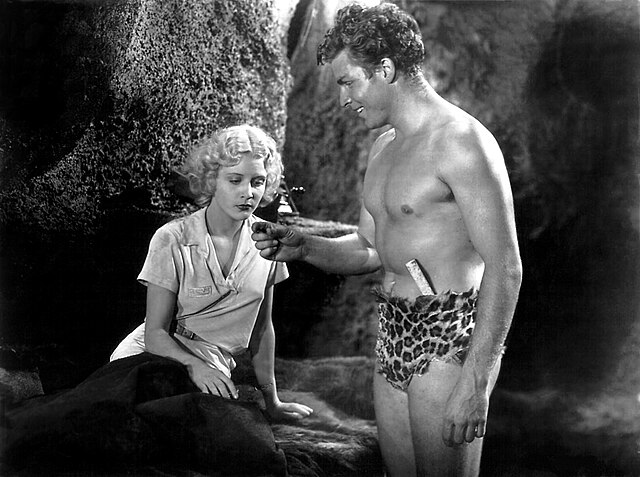
Tarzan - Photo: Public domain
Okello
These pebbles. They’re killing my feet.
I
It’s an Azov specialty. Don’t complain, you’ll get used to it in a day or two.
You see that pelican over there? There’s a myth that during a merciless winter, a mother pelican wounded her own chest to feed her chicks with her blood, because there was nothing else. She gave her life so they could live. People here never forgot that story.
Do you have pelicans in your country?
Okello
We do. We have the great white pelican, and the pink one too. You can see them at Queen Elizabeth National Park, right by Lake George and Lake Edward.
I
Wow. Elizabeth, George, Edward! They’ve named everything after your royals. What about you, William? Nothing in your honour? Or was there no English king named William?
Okello
I think there was one English king named William. But nothing in his name made it to Uganda. You could call it discrimination against me!
I
Look, look, there! That’s a seagull. You know, when a Cossack perishes in these waters, his soul becomes a seagull.
Okello
You’ve got quite a few myths around the Azov, don’t you?
I
We do. That’s what I’ve been collecting these past few weeks. You know, the one I like best is the Cry of the Crane. They say if you listen closely, you might hear it. A sound that once brought an old man back to life after he lost everything when invaders destroyed his village. The same cry is believed to guide the souls of fallen warriors and lost loved ones to the heavens. It heals the living and carries the dead.
Tell me your story, Okello. Your rivers, lakes, and waterfalls.
Okello
When I was in college in Kampala, I used to visit Lake Victoria with friends. A one-way ticket cost about a dollar, which felt like a luxury back then. Lake Victoria is where the White Nile begins.
But my best memories are from trips to Murchison Falls with my parents. It’s not far from Gulu. That’s where the Nile squeezes through a narrow gap and crashes down in this huge, roaring waterfall. The national park around it is full of life—elephants, giraffes, lions, antelopes. The river’s packed with hippos and crocodiles. And the birds—so many, including the shoebill. It all feels like heaven.
I You don’t need to travel to Murchison Falls to find heaven, Okello. See those cranes by the sea? I told you before, they carry souls to heaven.
Okello
Will they carry me back to earth, too? Because I’d really like to experience heaven while I’m still here.
I
That’s not possible. Because on earth, there’s no heaven. There’s only hell.
Okello paused, then turned. We started walking away from the water, toward a bench. When we reached it, we sat down.
Okello
You know what? Pain is inevitable. Suffering is a choice.
I
Okello, said that?
Okello
No. It sounds like a teaching of the Buddha. A Japanese storyteller only gave it words. But that doesn’t matter. What matters is the logic.
Pain—you can’t avoid it.
Suffering is your own response to the pain. It doesn’t come from the world. It comes from you. And only you decide what to do with it.
I
You think I’m choosing to suffer? Did you forget what happened to me?
Okello
I know. It’s easier to talk when I’m not the one suffering. But suffering grows when we argue with reality. We wish things were different. We hold on to stories that no longer fit the world we’re in.
Just try to see things as they are. Not through hope or fear, but through clarity and awareness. Accept the reality and move on.
I
I wish I could accept the reality. But it feels like I’m burning in hell, with no way out.
Okello paused again. He turned to face me. There was something in his eyes, something unsettled, maybe even irritated.
Okello
There is no hell.
I
I know there’s no hell on earth. But, you understood what I meant.
Okello
There is no hell. Anywhere.
I
Not even in the afterlife?
Okello
No. Nowhere. Hell doesn’t exist.
I
You’re an atheist. You can say there’s no hell. That’s your opinion.
But people who believe in religion know there’s hell in the afterlife.
Okello
There is no hell in religion either.
I
What?
Okello
Hell is a mind control mechanism, invented by the Roman Catholic Church.
The conversation drifted back to politics. Okello rarely stays away from it for long. A man was passing by with a basket of snacks. Okello waved him over, bought two packs of chips for us, and a bottle of beer for himself.
Okello
The beer’s warm. I don’t like it when it’s not chilled.
I
Maybe it was brewed in hell. It’s hot down there.
Okello
There’s clear historical evidence that the concept of hell did not exist in the pre-monotheistic era. The logic is simple: belief systems at the time were not centralized. Without a unified authority or doctrine, it wasn’t possible to imagine something as structured and absolute as hell.
You remember I once told you how the monotheistic religions all came out of that narrow corridor of West Asia and North Africa? A lot of people think the idea of hell started with them. But that’s not true. Just read their scriptures.
I
You mean Zoroastrianism and Judaism didn’t have a concept of hell?
Okello
They had a different concept of purification, not eternal burning. In Zoroastrianism, the wicked go to the House of Lies, a dark, unpleasant place. However, evil is ultimately destroyed, souls are purified, and all are reconciled. The period of purification is temporary; some traditions suggest it lasts up to three years.
In Judaism, Gehenna isn’t necessarily a place of eternal damnation. It’s more like a temporary state where souls go through purification, usually no longer than twelve months. Some rabbis even compared it to a washing machine: the soul goes in stained, endures a rough cycle, and comes out clean.
I
So, was it Christianity that introduced the idea of hell?
Okello
The modern idea of hell developed through the interpretation of several ancient concepts. Sheol from the Hebrew Bible, Gehenna from Jewish tradition, and Hades from Greek mythology. Over time, these ideas were shaped by Roman Catholic theological thought. In the 17th century, the King James Version of the Bible brought them together under a single term called hell, which came to represent a place of eternal torment in popular understanding.
I
Why did you say hell is a mind control mechanism?
Okello
Think about it. Why did the Roman Empire adopt Christianity? To unify its diverse populations under one political and religious framework and tighten centralized control, right? Now, let me show you how the concept of hell gave them a level of control no empire or regime had ever achieved before.
I was drawn into the conversation, but by then, night had fully settled. We were the only ones left on the bench. So we stood up and began walking. My home and Okello’s hotel were in different directions, like two corners of a wide triangle, but we headed toward mine. I figured he’d take a taxi from there after walking me home.
I:
Don’t worry about how empty the streets are in this part of town. Mariupol has surveillance cameras everywhere. We’re safe.
Okello
You know Stalin spied on his people through hundreds of thousands of agents in the NKVD, MVD, and MGB. Now imagine how convenient it would’ve been for him if he’d had surveillance cameras in every home, every bedroom, every street and highway across the Soviet Union.
I
That’s not possible.
Okello
The Roman Catholic Church managed it.
I
How?
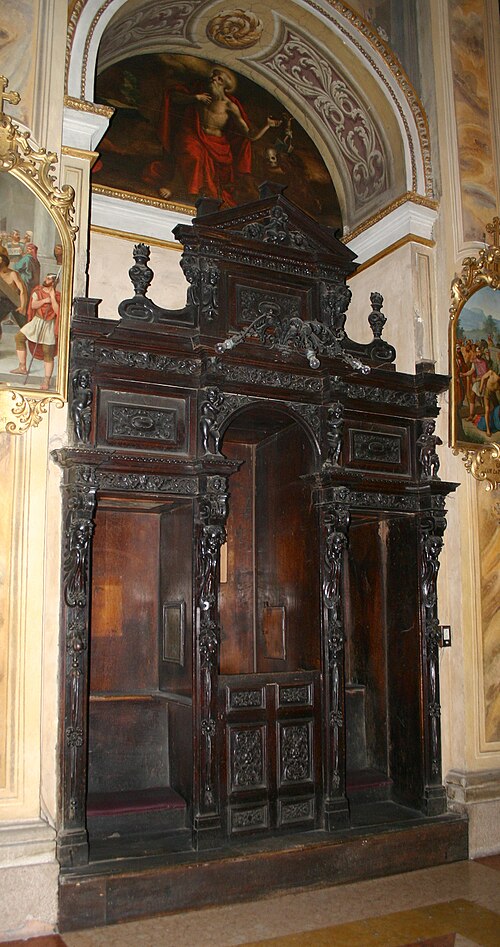
Milano - Sant'Alessandro - Confessionale - Photo: Giovanni Dall'Orto
Okello
I’ll get to that. But first, you need to understand the most potent part of the game is making people believe in a place where they’ll burn forever.
Not just fire—flames that peel your skin, pain that never stops, no end, no mercy. Who would dare risk that?
Once the fear takes root, people become desperate to avoid that fate. And when they’re desperate, they look for someone to save them. That’s when you step in and say: Follow me. Obey me. I’ll keep you safe. I hold the key to salvation.
I
And where is the surveillance camera?
Okello
Confession, also called the Sacrament of Penance. It’s one of the seven sacraments in Christianity. You go to a priest, confess your sins, and he grants you forgiveness. Just like that, you’re reconciled with God and the Church.
I
Hell, no…
Okello
Exactly. You don’t wait for the NKVD to come spy on you. You go to them and report yourself. From that moment, they own you. Only they can save you from hell. Otherwise, you go to hell and burn forever.
I
Interesting. But aren’t you oversimplifying? So, as you said earlier, the concept of hell gave the Roman Church a level of control no empire ever achieved?
Okello
Just look at what happened to the Roman Catholic Church. As long as people believed it had the power to save them from hell, it could even sell indulgences which offered salvation in exchange for money. But when Martin Luther exposed that the Church didn’t truly hold that power, its grip on the people began to crumble.
We reached home. I invited Okello in for dinner, though I already knew he’d decline. He smiled and said he’d grab something on the way back to the hotel.
Pain is inevitable, suffering is a choice. It keeps repeating in my mind. But, the more I try to adapt to the reality, the more I think about Igor, the war, the near-death feeling I had during the solitary confinement.
Okello’s thoughts about hell as a mind control mechanism have been giving me some relief. Not because they solve anything, but because they keep my mind busy. I’ve found something to occupy myself, something that distracts me from my own suffering.
Most of my day goes into research and thinking. I try to understand his theory, push back against it, question it, then circle back and see it differently. Again and again.
In the late 11th century, during the First Crusade, Pope Urban II promised full indulgence to anyone who joined the war, complete forgiveness of sins and a guaranteed place in heaven. The consequences were brutal. On their way to Jerusalem, the Crusaders wiped out entire Jewish communities in cities like Speyer, Worms, and Mainz. And when they finally captured Jerusalem in 1099, they killed thousands of Muslims—men, women, and children—convinced that their violence was holy, their sins already erased.
How much power over the human mind does it take to convince them that non-Christians were savages and that Christians had a divine right to convert them, conquer them, burn them, enslave them, kill them at will?
Pope Borgia literally divided the non-European world between Spain and Portugal in the Treaty of Tordesillas. They even had a name for it—the Doctrine of Discovery.
Since reading about it, the phrase Discovery of America makes me sick. The largest act of human extermination in history, buried beneath a single word: Discovery.
Did people ever discover that their minds had been controlled, tricked into believing monstrous things through a mechanism called hell?
Pope Borgia died of malaria. I don’t take pleasure in anyone’s death. But isn’t there something in that? A message from nature, maybe? A man believed to represent God on earth. A man said to have the power to save souls from hell, to divide the world and give it to whomever he pleased. And yet, he was brought down by one of the tiniest creatures visible to the naked eye—a mosquito.
I will go back to Kyiv. Yes, I will. Let my classmates call me a traitor, a separatist—whatever they want. I’m still alive. And I will live. I won’t let my own thoughts kill me before death does.